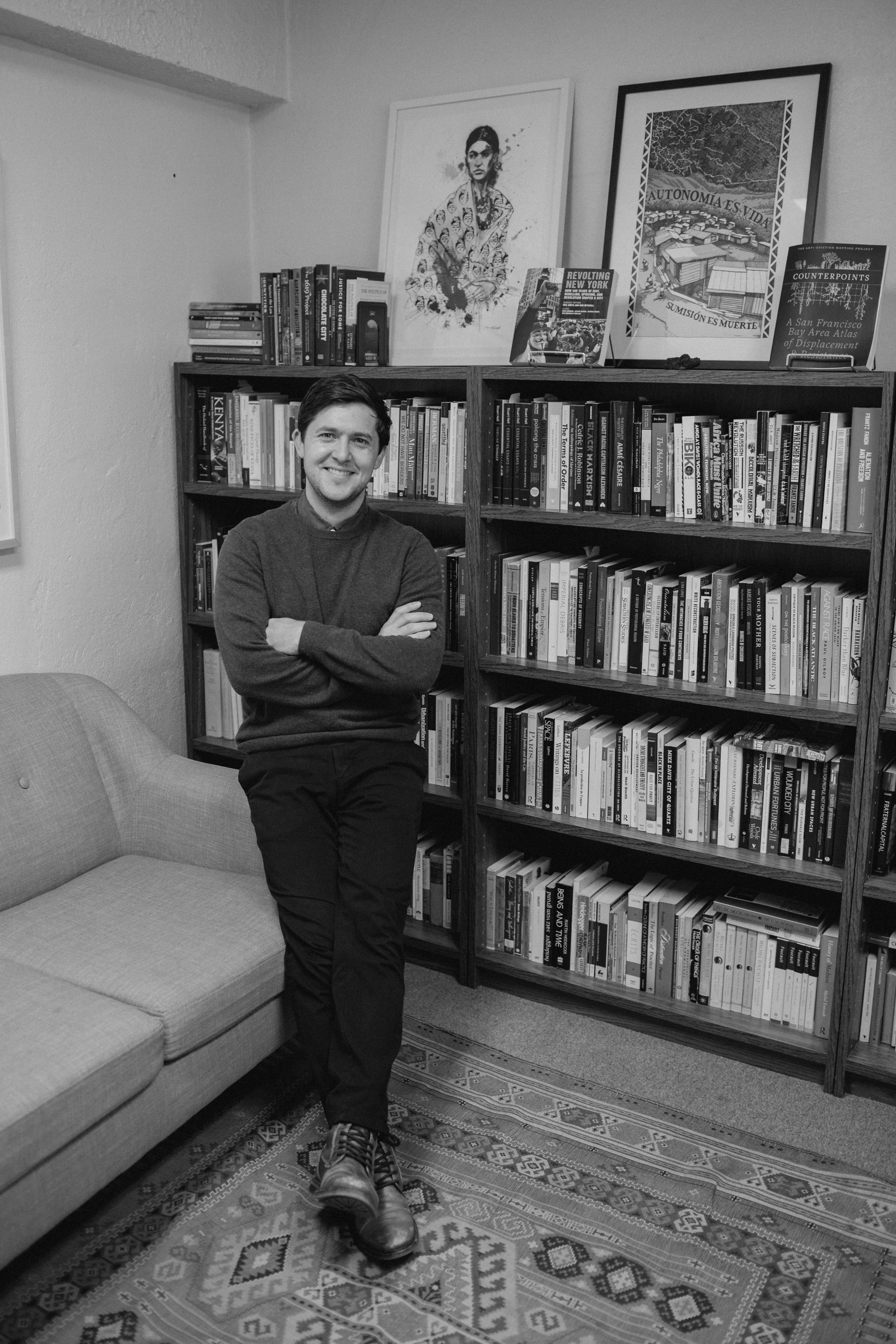
 At American University, I teach both graduate and undergraduate courses on anthropological theory, racial capitalism, security, colonialism and post colonialism, as well as our the core theory class for PhD/MA students in the Department of Anthropology. Previously at Northeastern University, I taught courses on globalization, development, security, war, militarization, cities, social justice.
I am interested in supervising projects on topics on security, international conflict, social movements, urban studies, racial capitalism, decolonization & postcolonialism. My regional areas of expertise are Sub-Saharan Africa and the Indian Ocean, but I also supervise students working in Latin America, Europe and North America. Potential PhD students are welcome to sign up for my email me or sign up for my office hours.
Syllabi for selected courses are available below.
Racial Capitalism and the Colonial Present [ANTH 439/639] (Syllabus (8.31) Racial Capitalism and the Colonial Present Syllabus)
The course examines the entangled histories of capitalism, racialization, and colonialism as major forces shaping our present world. Fundamentally, it engages the question of how capitalism, since its inception, has been structured by race/racialization as a major axis of inequality and exploitation. Alongside this theoretical preoccupation with the racial nature of capitalist political economies, we examine the major role that colonization and imperialism have played historically in shaping capitalist development. These forces (racialization and colonization) continue to shape to present articulation of capitalism in the world today, producing what some scholars call “the colonial present.”
This seminar provides a sustained engagement with these two concepts: “racial capitalism” and “the colonial present.” While both concepts have become touchstones of contemporary critical social sciences (in Anthropology, Geography, History, American Studies and others), the two are seldom theorized together. The theoretical core of this class will be: (1) to deeply think about the two concepts together through specific historical processes and (2) to examine their enduring power to structure the present (through uneven development, war, policing, prisons, urbanization, ecological vulnerability, etc.). Among others we will read Cedric Robinson, Neville Alexander, CLR James, Walter Rodney, Stuart Hall, Ruth Wilson Gilmore, Angela Davis, Ann Stoler, Lisa Lowe, Francoise Verges, Silvia Federici, Clyde Woods, Frantz Fanon, and Kwame Nkrumah.
Globalization, Development & Social Justice [SOCL 7221] (Syllabus SOCL7221)
This graduate seminar explores the dynamics of neoliberal globalization and its impact on local communities, nation-states, cities, and other spaces and places around the world. It examines the articulation of local-global forces as well as complex patterns of resistance ranging from place-based struggles to transnational social movements. The course begins by considering diverse sociological approaches to development and underdevelopment in the world capitalist system, including modernization, dependency, and world systems theories. We then examine the concepts of racial capitalism and gendered capitalism to provide theoretical grounding for understanding diverse forms of accumulation and resistance within the world system. Next, we turn to Haiti to theorize the longue durée histories of revolution and counter-revolution, followed by readings on new imperialisms of the present-day. We then explore the emergence of neoliberalism and contemporary finance capital, as well as alternative popular and grassroots movements at local, regional, and transnational scales. This is followed by several classes on the global production, gender, race, and migration in China and across the U.S.-Mexico border, the making of racial capitalism through oil extraction in Africa, and resistance against the prison-boom in California. We conclude with readings on the globalization of the police and the long counter-revolution, alongside emergent urban and transnational social movements. The class combines theoretical analysis of global capitalism, neoliberalism, development, and resistance with the study of concrete struggles in defense of land, labor, human rights, indigenous cultures and identities, and ecological sustainability in Africa, Asia, The Caribbean, Latin America, and the United States.
Cities in Global Context [INTL 3200] (Syllabus INTL3200)
Cities today are caught in processes of massive upheaval and global social transformation. Some cities are awash in capital as global finance injects massive amounts of cash into urban real estate markets transforming cities in the image consumption, luxury condos, and rampant gentrification. Other cities are awash in violence, caught in the nexus of war, insurrection, and expanding security infrastructures. Across the world, dynamics of urban segregation, exclusion, and apartheid which manifest today have deep historical roots which need to be excavated. And conversely, cities are today (and have historically been) important sites of rebellion, protest, insurrection, and revolution. Everywhere climate change threatens to radically transform society and the urban fabric of our world. This course takes the social and political questions surrounding these volatile dynamics of contemporary urban transformation, focusing-in on several cities and zooming-out to analyze the broad axes of power (race, class, capital, security and environmental crisis) through which cities across the globe are being transformed. Drawing on readings in urban anthropology, sociology, and critical geography, we will ask how cities are being radically restructured in the contemporary period. Broadly, we will develop an analysis of how power works in and through the city – that is, how the urban fabric itself becomes a medium through power operates. More narrowly, the course will ask: How is urban space produced? Who has the right to shape the city? How is urban exclusion and segregation maintained and reproduced over time? How are divisions or race, class, gender, and historical patterns of marginality reproduced in the city? How do political imaginaries shape the city? And what can contemporary urban forms and processes tell us about the future of urban life on the planet?
Security, Culture, Power [INTL3450] (Syllabus INTL3450)
From gated communities to neighborhood watch groups, internet surveillance to counterterrorism operations, anti-refugee populisms to the proliferation of prisons, security increasingly permeates every aspect of modern life. As Joseph Masco has written: “If you use a computer, phone, or credit card you are likely interacting with the security state and your records are likely to be stored for many years.” How did we get here? And how should we understand security’s ubiquity? In this course we will explore security as a set of historical and contemporary phenomena. We will develop tools to critically understand and analyze what security is and how it operates. We will begin with theoretical readings on security from Foucauldian and Marxist approaches, critical security studies, critical race theory, feminist and queer theoretical approaches in order to theorize and grapple what security does in the world today. We will dig deep in the history of security, examining the logics of exclusion, enclosure, colonialism, racial and gendered subjugation and dispossession as pivotal for understating the logic of security in the modern world. This historical and theoretical grounding will then provide the foundation for examining important contemporary topics in security: prisons, policing, migration, empire, urban redevelopment, military bases, and the war on terror. Through the course, students will develop a critical analysis of how power operates through security, and how security in turn produce and reinforces structures of inequality, spatial segregation and violence. As such, the course offers a critical and interdisciplinary approach to the study of security. In dealing with questions of how security shapes cities, states, space and society from the cultural and psychological terrain of fear to the international terrain war, migration and transnational conflicts, students will analyze the politics, culture, geography and history of security as a major force shaping the contemporary world.
Political Anthropology: Empire, Militarization and The War on Terror [ANTH 3417] (Syllabus ANTH3417)
This seminar in Political Anthropology examines some of the major social, political and cultural transformations precipitated by the so-called “global war on terror.” While the headlines in the news read of terrorism, drone attacks, and the possibilities of a new war in the Middle East, this course takes a critical look at the discourses, cultures, economics, and politics of our present era of permanent war, asking: how did we get here?Taking a critical anthropological lens on the war on terror, the course focuses on pressing contemporary questions about the militarization of culture, the political economy of permanent war, the colonial roots of counterinsurgency, and geopolitics of islamophobia. It has been nearly two decades since the inception of the wars in Afghanistan and Iraq, and today the world is arguably more insecure, violent, destabilized, and conflict prone than ever before. “Terrorism” has become an expedient global category everywhere for security and political repression as well as the construction of vast military and security apparatuses. In this course, we will both follow current events and discuss them in class. But ultimately, students will develop tools to understand present day conflicts in relation to longer genealogies of conquest, colonialism, war, and racism that in many ways still form the cultural and political underpinnings of American imperialism and shape our present world.
 Zoltán Glück